
What Is a Logogram? Meaning, History, and Why It Matters for Logos
Orhan Yilmaz, founder of Logogram.io. Designer building vector logo tools.
Published March 12, 2026 · Updated August 23, 2026
A logogram is a written character that represents a whole word or morpheme rather than a speech sound. The word comes from Ancient Greek logos (word) and gramma (that which is written or drawn). Also called a logograph or lexigraph, it is the unit of a logographic writing system. Everyday English examples include & for "and", $ for "dollar", and the numerals 1, 2, 3. Chinese characters such as 山 for "mountain" are logograms too.
Alphabets encode sound. Logograms encode meaning: a word, or the smallest meaningful piece of a word. The name of our logo platform is not a coincidence; more on that at the end.
What does the word logogram mean?
Split the word and the definition is already there. Logos is "word," "speech," or "the thing meant." Gramma is "that which is written or drawn." It is, literally, a drawn word.
English borrowed the term in the early nineteenth century. Dictionary.com dates the first recorded use to about 1810–20. Merriam-Webster and Britannica give the same core sense: a character that stands for a word. Pronunciation is US /ˈlɔːɡəˌɡræm/, UK /ˈlɒɡəɡræm/.
Synonyms you will see in linguistics are logograph and lexigraph. Related forms include logography (writing with such signs) and logogrammatic (made of them). The Wikipedia entry on logograms is a reliable overview of the same distinction.
The Greek root also feeds English logo, by way of logotype: type that sets a whole name as one distinctive word. That etymological fork matters later. A logotype is still letters. The other term names a sign that has become the word.
How logograms work compared with alphabets
A phonogram stands for a sound. Letters in an alphabet, kana in Japanese, and the letters of pinyin are phonograms. By themselves they have no meaning. You assemble them until a word appears.
A logogram works the other way around. The sign already is the word (or a morpheme). You do not sound it out letter by letter. You recognize it, the way you recognize & without spelling A-N-D.
That contrast is real, and it is also incomplete. Every historical logography also has a phonetic side. Scribes needed a way to write names, grammatical endings, and words that had no convenient picture. The usual solution is the rebus principle: take a sign for its sound and reuse that sound to spell something else. Peter Daniels and William Bright describe this mix throughout The World's Writing Systems (1996). Wikipedia's overview of the topic makes the same point. If you skip it, you repeat the myth that logographic scripts are "pictures of ideas."
In practice, a working logographic system does four jobs at once:
- A core inventory of signs that stand for words or morphemes.
- Phonetic reuse of those signs (rebus) to spell other words.
- Determinatives or radicals that narrow meaning when a sign is ambiguous.
- A mixed typology: logosyllabic scripts (Sumerian, Chinese, Maya) write syllables as well as words; Egyptian is often called logoconsonantal because its phonetic signs write consonants.
You do not need a seminar in typology to use the idea. Alphabets tell you how a word sounds. These signs tell you which word it is. Real writing systems almost always do some of both.
Logogram vs pictogram vs ideogram (and vs a logo)
These terms get swapped in casual speech. In linguistics they are not synonyms, and branding adds three more that dictionaries of writing rarely mention.
| Term | What it stands for | Example |
|---|---|---|
| Pictogram | Looks like the thing itself | A drawing of a sun; 木 as a tree |
| Ideogram | An idea, not necessarily one spoken word | No-smoking sign; 上 / 下 for up / down |
| Logogram | A specific word or morpheme in a language | & = "and" / "et" / "y"; 馬 = horse |
| Phonogram | A sound | Letters, kana, pinyin letters |
| Logo | A brand identifier (design term) | A swoosh, crest, or app icon |
| Logotype | A brand name set as distinctive lettering | Coca-Cola script, Google wordmark |
| Monogram | Combined initials as one mark | Chanel CC, Yankees NY |
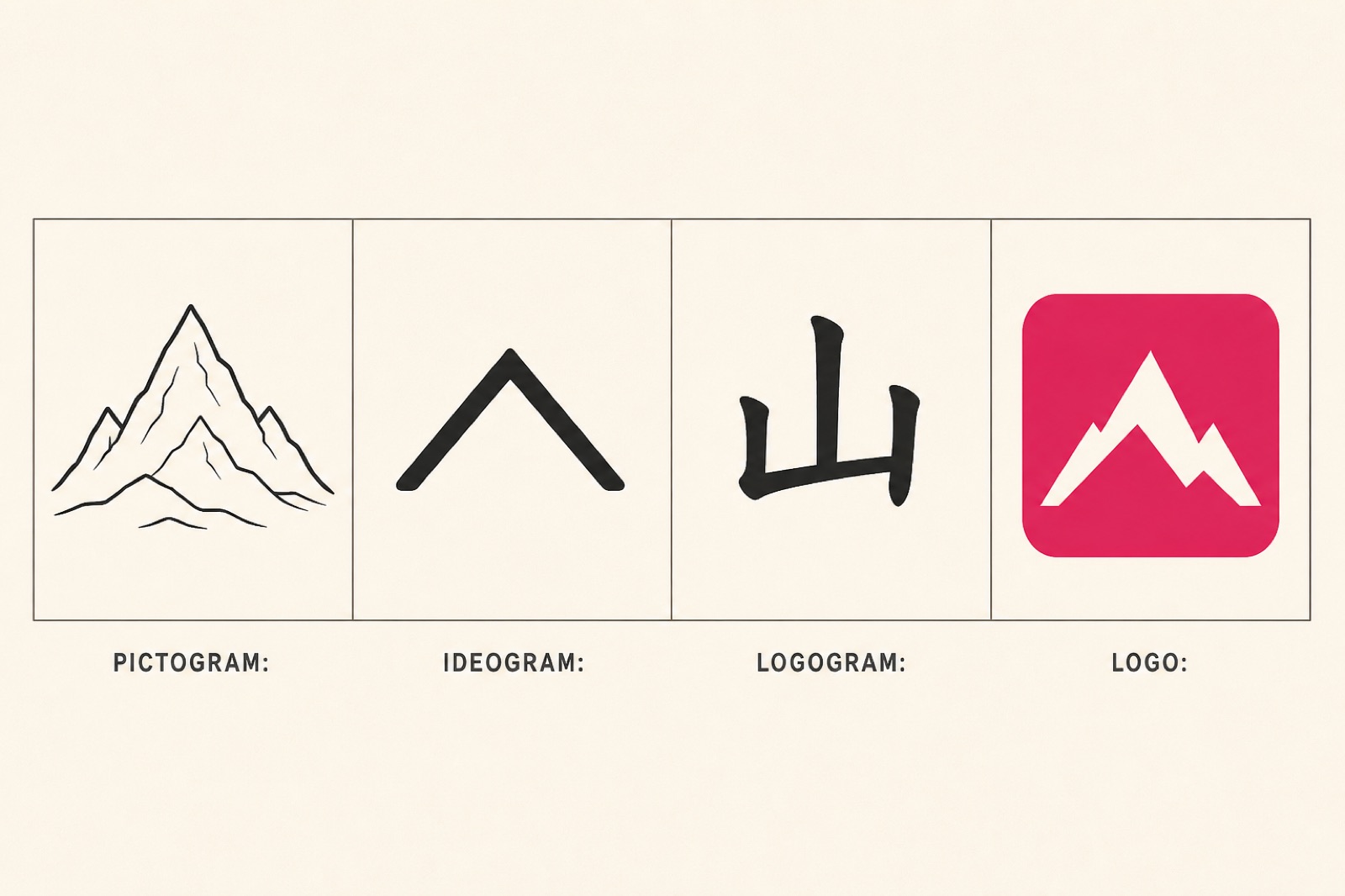
The difference between a logogram and an ideogram is that the former stands for a specific word or morpheme in a language, while an ideogram stands for an idea that may not map to one spoken word. The no-smoking sign is an ideogram: it communicates a prohibition without spelling "no smoking" in English or any other language. The character 馬, by contrast, writes a particular word: horse in Chinese, with a pronunciation that varies by dialect. Pictograms sit one step earlier. They look like the thing they denote, as 木 still faintly resembles a tree. English branding language adds a separate family of terms. A logo identifies a brand. A logotype is that name drawn as distinctive lettering. A monogram fuses initials. None of those three is a unit of a writing system. Modern linguists, following John DeFrancis, prefer logographic or morphosyllabic over the older label "ideographic" for Chinese.
Logogram examples in English and everyday life
English is an alphabetic language. It still leans on logograms whenever a single sign is faster than spelling.
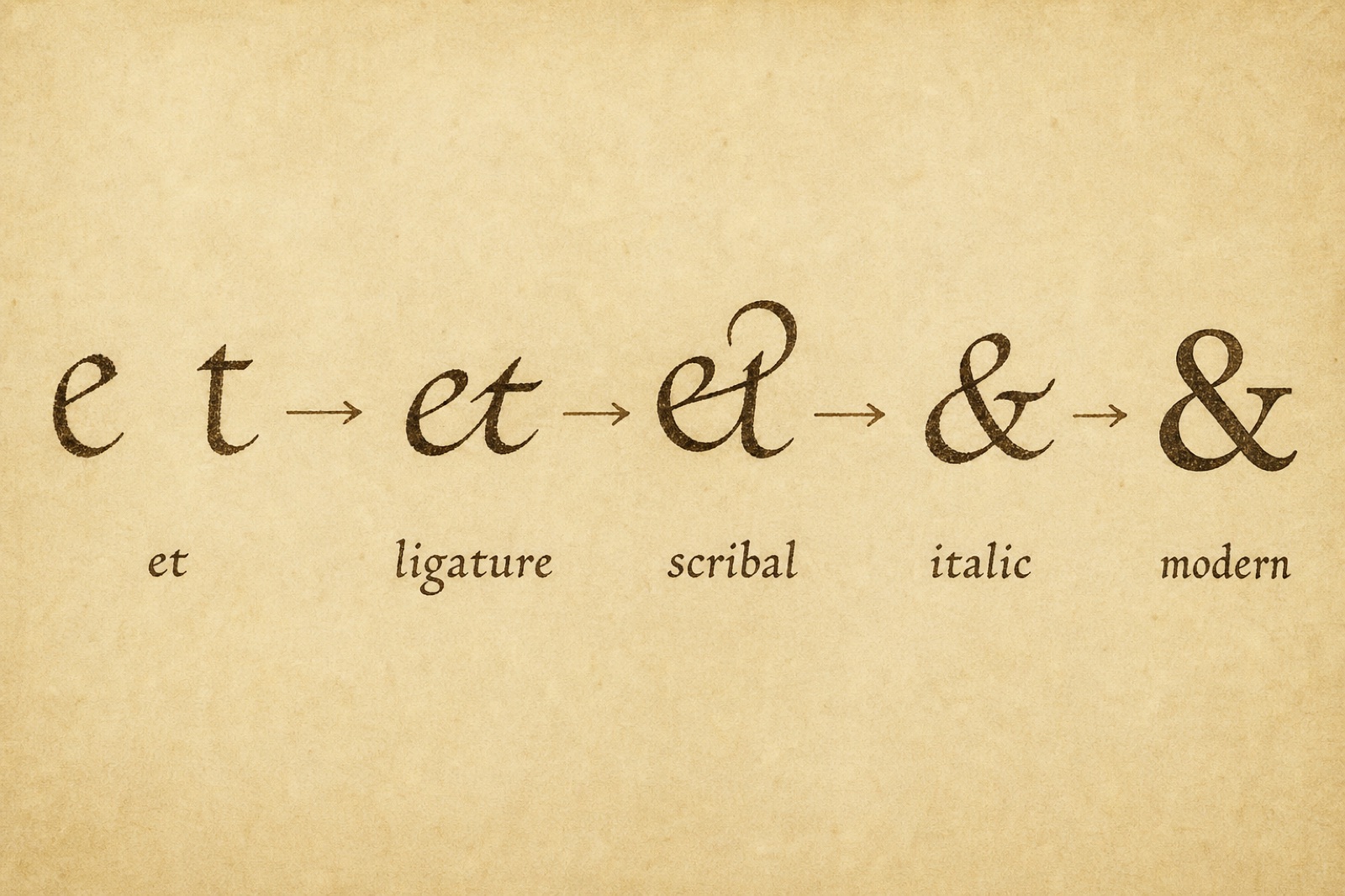
- & (ampersand): a ligature of Latin et, still read as "and" across languages that say and, et, or y.
- Currency and quantity: $, €, £, %.
- Addressing and rights: @, #, ©.
- Numerals 0–9: one written sign, many spoken words (one / ichi / wāḥid).
Unicode is the modern warehouse for these signs. A phone can store thousands of them, from $ to 山, as named characters rather than drawings you invent on the fly.
Emojis are usually pictograms or ideograms, not true logograms. A smiling face looks like a face; a no-entry emoji stands for a prohibition. They become logogram-like only when a community treats one as a fixed word with a stable reading. That is a social fact, not the default. Do not flatten emoji into "modern hieroglyphs" and stop there.
A short history of logographic writing systems
Logographic writing is among the earliest ways people recorded language. Four traditions matter most. Dates below are conventional, not claims of a single inventor in a single year.
Sumerian cuneiform
In southern Mesopotamia, around 3200 BCE, accounting signs pressed into clay became writing. Early tablets tracked grain and labor. As the system grew, scribes used rebus to write sounds that pictures could not capture. The result was a mixed logosyllabic script: word-signs plus syllabic signs, in wedge-shaped impressions. Cuneiform later wrote Akkadian and other languages with the same toolkit.
Egyptian hieroglyphs
Egyptian writing mixed word-signs with phonetic signs that write consonants. Egyptologists often call that mix logoconsonantal. Determinatives sit beside a spelling to narrow meaning, so a sign for a house is not mistaken for a similar-sounding word. Rebus, again, supplied sound. Monumental hieroglyphs stayed pictorial; hieratic and demotic scripts simplified the same system for ink.
Chinese hanzi
Chinese characters are the only major logography still used as a primary script. Readers of Mandarin and Cantonese can share a written sentence even when the spoken words diverge. That dialect independence is a practical advantage of encoding morphemes rather than one dialect's phonemes. The script was borrowed into Japanese as kanji and into Korean as hanja; both languages then layered their own phonographic systems beside it.
Maya and other Mesoamerican scripts
Classic Maya writing is logosyllabic: word-signs plus syllabic signs, often with phonetic complements that confirm a reading. Other Mesoamerican traditions used related strategies. They are independent inventions, not copies of the Old World scripts above. Optional aside, if you collect rarities: Middle Persian Pahlavi used heterograms, Aramaic word-signs read as Persian words, another reminder that the point is reading, not looking like the thing.
Are Chinese characters logograms or pictograms?
Chinese characters are logograms, not pictures of ideas. Traditional analysis lists six formation types (the liushu), including pictograms and simple ideograms. Those types exist. They are a small share of the inventory people actually read.
About 90 percent of characters are radical-plus-phonetic compounds: one part hints at meaning, the other hints at sound (Li and Kang, 1993). Take 妈 (traditional 媽), "mother." The left side is 女, the woman radical. The right side is 马 / 馬, historically read like mā, used here as a phonetic. You cannot guess "mother" from a drawing of a horse. The sign is a word-character with an internal phonogram, not a sketch of maternity.
John DeFrancis argued this at length in The Chinese Language: Fact and Fantasy (1984). Treating Chinese as ideographic writing, he wrote, is a myth. The system is a logographic writing system with a large phonetic component, sometimes called morphosyllabic: each character typically writes a morpheme that is also a syllable. Kanji and hanja can be morphographic in a further sense, when a borrowed character writes a native word whose sound does not match Chinese.
So: Chinese is not a pictographic language. A few famous characters still look like trees, mountains, or mouths. The working engine of the script is phonetic-semantic compounding inside a logographic frame.
Advantages and disadvantages of logograms
Why keep a costly inventory of word-signs when an alphabet is smaller to learn?
Compactness is the obvious gain. One character can replace a string of letters. Fast visual recognition is the second: practiced readers do not assemble a character from strokes the way beginners do. They see a unit. A third gain is writing that can outrun spoken dialect. Classical Chinese made bitan, "brush talk," possible: scholars who could not converse still shared a written sentence.
The costs are real. Literacy means memorizing thousands of forms. Studies of modern Mainland usage often cite about 3,500 common characters covering roughly 99.5 percent of a large sample. Input methods add another layer: pinyin (sound-based) versus shape-based methods. Japanese multiplies the problem with multiple readings for the same kanji.
Designers can steal the useful half of this tradeoff. A mark that is tiny, silent, and still "read" as a brand is doing logogram-like work. The cost, if you skip the reading, is decoration that nobody can name.
How a logo is like a logogram (and how it is not)
A logo is not a logogram, and the two words are easy to confuse because they share a Greek root. In linguistics, the latter is a character in a writing system that stands for a word or morpheme. In design, a logo is a brand identifier: a mark, a word, or a combination that tells you which company you are looking at. The Nike swoosh does that job well. It does not spell a word in English or any other language, so it is not one of these characters. What the two share is compression. A word-sign skips sounding out letters and delivers a word in one glyph. A strong logo skips a paragraph of explanation and delivers a brand in one mark. Both can travel across languages. Neither should be treated as a picture of an idea with no reading attached. If nobody can say what the sign stands for, it is decoration.
That is why professional process still starts with meaning. We wrote about this in our note on concept-first logo design: a concept and a Design Story before pixels, then an editable SVG. A word-sign without a reading is just a shape. A logo without a rationale fails the same way.
Monograms sit on the border. Initials are letters, so a monogram logo generator is not minting writing-system characters. Combined well, those initials become one readable symbol, which is why we also keep a longer guide to monogram logos. The how-to walkthrough is the practical companion if you want to try the same sequence in the editor.
Why we named the platform Logogram
I named the company Logogram because I wanted the product to do what the word describes. A professional logo should behave like a drawn word: one mark that carries the whole name. Not a clip-art mascot, and not a prompt that hopes a pretty shape will appear.
The argument has three layers, and they are not a pun. First, etymology. Logos is the word, the reason, the thing meant. Gramma is that which is written or drawn. A logo worth shipping is a drawn word: a mark that carries the whole name. Second, function. The platform is built to make single marks that stand for a whole brand, the way & stands for "and." Our specialization in monograms and lettermarks sits on the border between letters and word-signs: initials become one readable symbol. Third, process. Logogram.io starts with meaning before pixels. Concept generation states what the mark should say. Vector rendering makes a file you can edit. A Design Story writes the reading down so a client is not left guessing. That sequence mirrors how a logogram encodes semantics, not just shape.
In some design communities, especially in Indonesian and Malay usage, logogram is used loosely as a synonym for "logo." That usage exists; people will search it. We are claiming the stricter linguistic sense. The output of the tool is still a logo in the design sense. It is not, by itself, a character in a writing system.
If you want a mark that can function like a logogram for a brand name, generate one on the homepage or start from the logo generator. New accounts include free credits.
Frequently asked questions
What is a logogram in simple terms?
A logogram is a written sign that stands for a whole word or a meaningful part of a word, not for a spoken sound. The ampersand & writes "and." The digit 3 writes "three." Chinese 山 writes the word for mountain. Alphabetic letters, by contrast, only tell you how to pronounce.
What is the difference between a logogram and an ideogram?
A logogram writes a specific word or morpheme in a language. An ideogram stands for an idea that may not be one spoken word. The no-smoking sign is an ideogram. Chinese 馬 writes the word horse. Linguists now avoid calling Chinese writing "ideographic" because most characters encode words with phonetic clues, not floating ideas.
What are examples of logograms in English?
English is written with an alphabet, but it still uses logograms every day: &, $, €, £, %, @, #, ©, and the numerals 0 through 9. Each sign is read as a word. Unicode catalogs thousands of these signs for screens and print.
Are Chinese characters logograms?
Yes. Hanzi are the units of a logographic writing system, and the only major one still used as a primary script. They are not a pictographic language. About 90 percent of characters are phonetic-semantic compounds (Li and Kang, 1993). Pictograms and simple ideograms are a small historical share.
Is a logo a logogram?
No. A logo is a brand identifier in design. A logogram is a character in a writing system. A swoosh or lettermark can work like one (one mark, whole name) without being one in the linguistic sense. Calling them the same thing confuses two fields that only share a Greek root.
What is the difference between a monogram and a logogram?
A monogram combines initials into one mark, like Chanel's interlocking Cs. It is built from letters. A logogram stands for a whole word or morpheme. Some lettermarks sit near the border: initials become one readable symbol. They are still design objects, not writing-system characters.
Why is the company called Logogram?
We named the platform for what a professional mark should do: stand for a whole brand the way a logogram stands for a whole word. Logos plus gramma: the drawn word. The product starts with meaning (a concept and a Design Story), then renders an editable vector, rather than decorating first and explaining later.
Key takeaways
- A logogram stands for a word or morpheme, not a speech sound. &, $, and 山 are everyday cases.
- Pictograms look like things; ideograms stand for ideas; logos, logotypes, and monograms are branding terms, not writing-system terms.
- Chinese characters are word-signs with a large phonetic component, not a pictographic language (DeFrancis; Li and Kang).
- Historical logographies always mix word-signs with sound via the rebus principle (Daniels and Bright).
- A strong brand mark can work like one of these signs. That is why this platform is named Logogram, not why its files "are" writing-system characters.